Saturday, 5 July 2008

The pick of the bunch

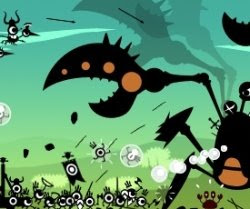
PataponTo go with my love letter to portable gaming, here are some of the better games to catch my eye over the past year or so:

Advance Wars: Dark Conflict (DS): A superior turn-based strategy affair, this game is an improvement over its predecessor simply by virtue of having characters you don’t want to drown.

Animal Crossing: Wild World (DS): Turn it on for half an hour a day and pay off your virtual mortgage while engaging furry convention rejects in inane conversations. It’s bizarrely addictive, and I had to forcibly give it up – the fact that I succeeded gives me hope in quitting smoking.

Beats (PSP): One of the few worthwhile downloadables on the UK website, Beats takes your saved music and converts them into levels – not unlike Vib Ribbon did so many years ago. Simplistic, but fun.

Crisis Core – Final Fantasy VII (PSP): A prequel to the original FFVII, Crisis Core is a simplistic semi-brawler that wouldn’t get away with its obvious design flaws if (a) it wasn’t Final Fantasy, (b) it was on a bigger screen or (c) it wasn’t so darn pretty. As it stands, it’s good fun.
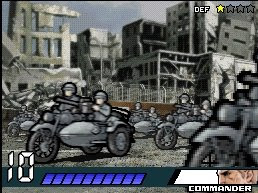
Advance Wars (DS)Final Fantasy Tactics: War of the Lions (PSP): An excellent port of the original PSX game, this is a stupidly complex and rewarding strategic role playing game. Prepare to sink in hours of preparation to get through a ten minute battle.

Final Fantasy VI (GBA / DS): A port of the old SNES classic, this game is one of the highlights of the whole series. The reduced screen size means that the old graphics still look gorgeous even to my jaded PlayStation eyes, and the story is heartbreakingly well told.

FlOw (PSP): It’s not a game, I think. I’m not sure what it is, but I lost a fair few hours of my life playing it.

God of War: Chains of Olympus (PSP): Everyone’s favourite Spartan kicks the shit out of more mythology. As brutal – and formulaic – as the PS2 releases, it has not lost its glossy prettiness in the translation.

Metal Gear SolidMetal Gear Solid Portable Ops (PSP): It’s Metal Gear Solid with comic book cutscenes and the ability to kidnap enemy soldiers. Stealthy goodness.

Patapon (PSP): Rhythm action battling. Save your Patapon nation by banging drums. Compulsively weird.

Platinum Sudoku (DS): I know, I know. It’s Sudoku. But there’s about 20 million of them on the cartridge, which means I’m never running out. FFVI aside, I’ve spent more time with this than with any other portable game.

Pokemon Diamond (DS): God, I wish I was joking. But underneath the kiddy graphics and plot, there really is a deep game with an incredible amount of stuff to collect and beat up.

Tekken Dark Resurrection (PSP): It’s Tekken 5, but smaller and with more stuff to do. It’s without a doubt the best fighting game available on a portable console, and perfect for a commute of any length.

Downsizing: how portable gaming has taken over from the big boys

It was a hard fight. Badly injured from the way through the mountains, I had to keep moving. Even armed with the famous Buster Sword, my opponent had the advantage – and my back was to a sheer drop. If he pushed me back…

We fought, I won. And then I got off the tube and went to work. It was eight thirty in the morning.

Portable gaming is nothing new. I owned one of the original Nintendo GameBoys – those of the ‘brick’ school of design. It saw a lot of use; mostly, I played Tetris, which was the game largely attributed to the success of the console. I had a couple of other good’uns: Probotector – the European version of Contra on the GameBoy – and BattleToads spring to mind, and I remember that one of the first games I ever actually completed was Terminator 2.

Around me, kids were starting to see consoles as something cool. Sega and Atari had their own portable entries at the time, with the GameGear and Lynx respectively. But these consoles were handicapped: the GameGear lasted about 20 minutes without a power cable, while no one ever found out how long the Lynx could be used for because no one could find any games for it.

The GameBoy wasn’t perfect; it could display four colours and had a sound system matched by the average household microwave. But it was fun, and its game library was arguably only ever matched by that of the PlayStation.

Later, I owned a GameBoy Advance. It was a mistake, in retrospect. I had no commute, and a PlayStation 2 at home, so it saw very little use. This is the problem with portable systems: portable systems are traditionally not as powerful as the beasts that lurk under our televisions, and up until recently, there has been no reason to use them if you didn’t travel anywhere.

Nintendo kicked me back into the portable market with their DS, which is backwards compatible with the GameBoy Advance. Its library of games is exactly what you’d expect from Nintendo: Mario, Zelda, StarFox, Metroid, and a million puzzle games populated by anthropomorphic animals. My problem with the games – cute factor aside – is that there is a curious number of them that seem to expect me to play them every day: Brain Age and Animal Crossing spring to mind.

Since then, I’ve picked up a Sony PSP. Only slightly less powerful than my PlayStation 2, it has all but taken over my gaming hours. Oddly, though, I am addicted to the PSP because I am being allowed to play the same games as I would at home; the difference is I don’t have to rush to finish if I want to go out.

It seems that Sony and Nintendo have finally learnt what we want out of portable gaming. It’s not such a hard list to figure, to be honest, and you have to wonder why it took them so long. We want a battery life of at least a couple of hours, otherwise what’s the point in the first place? We want good graphics, which is easy on a small screen: I played through the GBA version of Final Fantasy VI, which has the same graphics as it did on the SNES, and it looked glorious.

Most importantly, we want good games. Portable game design has gone up a notch since I last met it, mostly by directly emulating the full-sized console market. You now have the same standard of games, but with the option to switch off at any time thanks to the power-save options.

So, as I get older and my free time gets shorter, it seems portable gaming is becoming the way forward. I’ve become disillusioned with the new-gen consoles, as I still haven’t seen anything actually new. But portable gaming, previously so far behind, has now caught up, and is closer to the future than any other part of the market.

Friday, 25 April 2008

Why I generally dislike people - part 257

It's been a while since I posted about that day someone tried to burn me and fellow flatmates alive, so I figured I'd knock together a quick update. I'm not aiming for eloquence here, and it's a Friday morning, so there you go.

I had to give a police statement the following day, which involved me going down to the station in Bromley and talking very slowly for two hours. I am not good at talking slowly; I dislike doing so for the same reason I hate training people at work. My patience eventually just snaps like old trouser elastic, and then I wake up to find myself surrounded by bodies.

Mister Police Man was very friendly, and told me:
  1. Dave had admitted to wilful destruction of property.
  2. Nothing at all about a possible assault charge on the landlady.
  3. That they probably would not attempt to press charges for arson, as they would be concentrating on point number 1 instead.
And then I heard nothing until yesterday, when I was told by the landlady's son - who, let us not forget, performed a service to humanity by punching Dave - had been arrested for assault.

Yes, you read that right: Dave, smoulderer of the innocent and a man willing to openly threaten his landlady, his girlfriend and his flatmates, is pressing charges against someone who actually hits back. On the bright side, I guess, all those people back at school who said that "bullies are really cowards" finally got vindicated.

If this sticks, I will not be happy.

Thursday, 24 April 2008

There is now...

...an artist attached to this project.

That is all.

Monday, 21 April 2008

Review: Race for the Galaxy

Image credit: Board Game GeekI developed an interest in games – the non-video variety – last year, after reading the Joystiq ‘Off The Grid’ review of Chrononauts, a card game that is well worth picking up so long as you have at least one friend and enjoy watching Back to the Future. Since then, I have enjoyed Settlers of Catan and Carcassonne – both terrific gateway games – but the game that keeps calling me back is Race for the Galaxy, designed by Tom Lehmann and published by Rio Grande Games and Abacus Spiele.

RftG is a card game. Despite this, it comes in a box the size of a small moon, in a move apparently designed either to hold future expansions or simply to drive environmentalists crazy. Whatever the reason, the box contains 150 playing cards, a bunch of Victory Point chips of various denominations and more rules than an International Space Station toilet. RftG can be played by two to four people, and each game takes between half an hour and an hour.

Mike (my current gaming cohort) and I nearly gave up during our first play through. The rules are well written – and if you speak German, you get an extra set for free – as long as you already know how to play the game. Figuring the rules out for the first time is at best problematic, and at worst a fucking nightmare.

The premise of the game is simple enough: you are a galactic leader with a single planet under your control, and you must develop either the largest civilisation or the most powerful economy in the galaxy. Success is measured in Victory Points, which can be earned by colonising or conquering new worlds, developing a working production infrastructure, or simply by producing goods and selling them.

In order to do this, each player has a selection of action cards, with which they choose what they want to do in any given round. There are five different action phases – Explore, Develop, Settle, Trade / Consume and Produce – and each player has the opportunity to go through any phase selected by the other players.

This is where the game starts to get complicated: there may be only five types of action phase, but each player has access to seven different action cards. If you only have two players and are feeling brave, both of you get another four cards. That’s eleven action cards with which to select five possible action phases. And then a player has another hand for their developments and planets, which can contain up to ten cards.

Unfortunately, the booklet is missing an important page – a page so obvious that I can only surmise it was planned but left out by accident by the printers: a quick start page. A page that sets out not only what you have to do in each phase, but why you might want to in the first place.

Image credit: Board Game GeekTo further exacerbate matters, the game uses a system of symbols to define common card attributes. These symbols are explained in the rules – and, to be fair, they are for the most part logical once you get the hang of them – but they can take some time to figure out for new players.

Once you get past this initial deluge of cranial fluff – usually after two or three games – RftG becomes an arresting gaming experience. Lehmann delayed the initial release of the game several times for extensive playtesting, and this extra effort shows in the well-tuned game engine: RftG is immaculately balanced, favouring no single strategy over any other. Luck of the draw plays a factor, but so does planning and foresight, resulting in a game where no loss feels unfair and no triumph comes cheap.

Each card is a miniature masterpiece, with superb paintings depicting planets, alien technologies and galactic rebels. This creates a unique and consistent atmosphere: while it is unlikely that anyone but the insane will actually believe they are conquering outer space, Mike and I do find ourselves running to an ad-hoc plot as we play. Player interaction is limited, but it does exist: once you figure out an opponent’s strategy, you can rely on them to provide certain action phases while you select your own, essentially giving you more useful rounds.

The ending scenarios – twelve cards in your portfolio or all of the available Victory Points used up – come round quickly, which means that players need to make every card count. Every game becomes a tense race to the finish, as players try to end the game early to deny their opponents the chance to complete a card layout or make a final trade.

For anyone who doesn’t want to invest too much time into a game, RftG is a wasted purchase. The rules require active decryption, while the level of strategy within the game itself means that players should try to develop at least a basic familiarity with the individual cards in order to make the most of it. However, if you do have the inclination to learn and have at least one friend willing to put in the same effort, RftG is a deep, enjoyable diversion that is well worth the money.

Tuesday, 25 March 2008

Comic Collector: it seemed like a good idea at the time

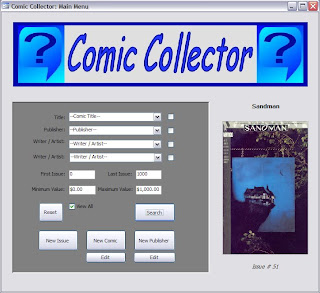
Comic Collector main menuIt’s a commonly held – and almost entirely inaccurate – belief that I am somehow a technically apt person. I think this is because I wear glasses. Ever since school, I have often been mistaken for someone who knows about computers. I have even fooled my employers: somehow, I work for a company that builds internet and intranet sites.

Truthfully, however, I am never going to be properly computer literate, mostly because I need to take my socks off whenever I count above ten. I once tried to update Windows 98 on my PC, with the help of a friend. We ended up having to rebuild the computer from scratch. After that, Windows displayed error messages in Czech.

I still have no home internet connection. Even my grandparents have broadband.

A couple of years ago – almost to the day, in fact - I decided that I needed a database to hold information on my rapidly growing array of comics. I trawled the internet for a few weeks, but didn’t have much success: all of the programs I found were ugly or simplistic, or just did something in a fashion I found counterintuitive.

Then I split up with my girlfriend, in part because she didn’t want to be going out with the sort of person who catalogued his comic collection. I went home after the break-up, and while I was there my dad gave me a copy of Microsoft Access.

I learned to use Access at school, during my Computing A-Level. It’s a pointless skill to have, as no one in the entire world uses Access for anything. I built a database that organised magazine articles for my A-Level coursework. It was my dad’s idea; I couldn’t think of anything else to do. While I was home, I dug out my old project and decided to use it as a template for a new, home-grown comic database.

This exercise has taught me that I don’t really build programs so much as grow them, much like I do mould in tea cups – an attitude that is going to get me in trouble at work very soon. My database, which started off as two tables and a simple query, now contains seven tables, nine queries and a user interface that would confuse a submarine operator. Including the inputted data, it stands proud at over 220 megabytes in size. And it’s still growing.

I haven’t even finished inputting all of my comics. It’s been two years.

The problem with my organic approach is that, because I have no plan and because I tend to put the project down and leave it for months at a time, I keep forgetting how it works. For example, there is a nifty feature that displays a random comic cover on the main menu screen. All of the comic covers are scanned in, so when you open the program it will show one of them with the title and issue number. I programmed this feature, and am rightly proud of it. But I have no idea how it works. I checked recently, and my methodology makes no logical sense. For all I know, the database offers a prayer to the fire rabbits of Pluto, who tell it what cover to display.

Yet I still keep dreaming up and adding new features. This weekend, I figured it would be a good idea to be able to assign categories to the comics, so you could search for which ones you have on subscription, or for anything in the Marvel Ultimate Universe, or whatever. It didn’t take too long to add the categories, but I haven’t even started building the relevant searches yet: that’s the work of another weekend. Just adding the categories required me to break and fix the program no less than four times.

It feels like I’ve built the damn thing out of lard. Sooner or later, I’m going to add something slightly too heavy and the whole program will slop into a melted, useless lump. God forbid I try and remove anything. A year ago, in the name of testing, I built a backup table that isn’t connected to anything important. I tried to delete it yesterday, and the whole database crashed. I don’t understand why, and probably never will.

I’m catching up with the data entry; I now have 498 comics logged, out of maybe seven hundred. I have decided that, in order to count this project as ‘complete’, I need to input the rest of the comics, finish the category search and add the functionality to print search results. And then I need to rejig the user interface, simply on a cosmetic level.

This may take some time.

Just one of my queries!
A sample search result

Tuesday, 11 March 2008

Up in flames: When real life burns out fiction

Image credit: http://www.sfgate.comThe most important hallmark of being a good writer isn’t necessarily being good with words. James Joyce proved that you don’t even have to be particularly good with grammar. If your story sucks, all the long words, run-on sentences and semi-colons in the world won’t save it. A good writer needs to be able to put together a top-notch plot.

Most good stories – even across genres such as sci-fi and fantasy – have strong roots in reality, which is why a good writer should be looking at real life for material. Real life mostly consists of the drudge of daily life, but it does throw up some gems if you search hard enough.

Take this, for example. True story.

A couple of nights ago, a guy – let’s call him Dave – had a bad day and got drunk. He had a few spliffs; not uncommon for him. He went home to his flat, where he lived with his girlfriend and a couple of others. One of these others – Dean – had been pretty loud over the last few weeks. Dave, in his drunken state, decided tonight was going to be the night when he pounded Dean into the ground. He had a theory that Dean was a crackhead, and who wants to live with a crackhead?

Of course, Dean wasn’t in. Dave, not to be put off, banged on Dean’s door. He then called up the landlady, accused her of forcing him to live with crackheads, and handed in his notice. He convinced his girlfriend to make the same call, and then continued pounding on Dean’s door. He accused everyone in the world of being a cunt, and threatened to beat anyone he saw. He wasn’t really angry with Dean; he just wanted a fight.

The landlady was somewhat surprised with the accusations of drug taking on Dean’s part, so called up her son and asked to be taken round to the flat. By the time she got there, Dave and his girlfriend were passed out in bed, and Dean’s door had a big hole in it.

It took ten minutes to wake Dave and his girlfriend. Instantly, Dave was throwing his weight around again, hurling insults at all and sundry. And then he took a swing at his seventy-five year old landlady.

Thankfully, the punch didn’t connect. The landlady’s son, a placid but big fella, stepped in the way and floored Dave.

There followed a few minutes of huffy, drunken walking around by Dave and his girlfriend, the latter being thoroughly pissed off by her hubby’s mood. The landlady and her son, feeling the situation was as resolved as it was going to get at half-midnight, started to drive home.

The peace didn’t last. Within ten minutes of being left alone, Dave started his ranting again. He threw things around, started on a second door – his girlfriend’s – and then decided that the only thing to do was set light to his mattress.

His girlfriend, giddy with fear, pleaded with him to stop. She tried to pour water over the mattress, but Dave wouldn’t let her. Instead, he took her by the neck and got her out of his room.

Meanwhile, the last housemate – the one who wasn’t Dean; the one who was in his room the whole time, and who had been on Dave's corncopia of people to beat, called the police. And then he smelled smoke, and called the fire brigade as well. He escaped the flat through his window, got help from upstairs, and went to find the girlfriend.

The girlfriend was on her own. Dave had skipped out, leaving her to douse the flames. The hall was full of smoke. The fire brigade turned up, dragged Dave’s still smouldering mattress and quilt out of the flat and turned on the hoses.

Dave wandered back while the firemen worked, and stood calmly to one side. Eventually, the police turned up and talked to everyone present, including the returned landlady and her son. Dave was duly arrested, and put in a cell overnight to detox.

Thus far, Dave has admitted causing wilful destruction of property. There’s every chance he’ll get done for trying to hit the landlady. He denies arson, claiming that he was drunk and just left a cigarette to burn by accident. The police do have a statement that the fire was deliberate, but it’s from the housemate who called the police. He heard everything, but didn’t see it.

So, yeah. Life chucks out some good old stories. The difference between real life and fiction, of course, is that the characters act differently. In a story, that last housemate would have rocketed out of his room and saved the day, doused the flames and brought Dave to some kind of justice. Frankly, though, I was fucking terrified.


Dean's door


Doused mattress