Showing posts with label psp. Show all posts

Saturday, 5 July 2008

The pick of the bunch

PataponTo go with my love letter to portable gaming, here are some of the better games to catch my eye over the past year or so:

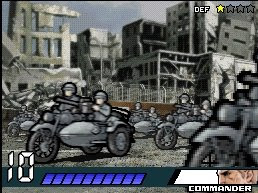
Advance Wars: Dark Conflict (DS): A superior turn-based strategy affair, this game is an improvement over its predecessor simply by virtue of having characters you don’t want to drown.

Animal Crossing: Wild World (DS): Turn it on for half an hour a day and pay off your virtual mortgage while engaging furry convention rejects in inane conversations. It’s bizarrely addictive, and I had to forcibly give it up – the fact that I succeeded gives me hope in quitting smoking.

Beats (PSP): One of the few worthwhile downloadables on the UK website, Beats takes your saved music and converts them into levels – not unlike Vib Ribbon did so many years ago. Simplistic, but fun.

Crisis Core – Final Fantasy VII (PSP): A prequel to the original FFVII, Crisis Core is a simplistic semi-brawler that wouldn’t get away with its obvious design flaws if (a) it wasn’t Final Fantasy, (b) it was on a bigger screen or (c) it wasn’t so darn pretty. As it stands, it’s good fun.
Advance Wars (DS)Final Fantasy Tactics: War of the Lions (PSP): An excellent port of the original PSX game, this is a stupidly complex and rewarding strategic role playing game. Prepare to sink in hours of preparation to get through a ten minute battle.

Final Fantasy VI (GBA / DS): A port of the old SNES classic, this game is one of the highlights of the whole series. The reduced screen size means that the old graphics still look gorgeous even to my jaded PlayStation eyes, and the story is heartbreakingly well told.

FlOw (PSP): It’s not a game, I think. I’m not sure what it is, but I lost a fair few hours of my life playing it.

God of War: Chains of Olympus (PSP): Everyone’s favourite Spartan kicks the shit out of more mythology. As brutal – and formulaic – as the PS2 releases, it has not lost its glossy prettiness in the translation.

Metal Gear SolidMetal Gear Solid Portable Ops (PSP): It’s Metal Gear Solid with comic book cutscenes and the ability to kidnap enemy soldiers. Stealthy goodness.

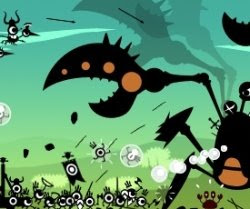
Patapon (PSP): Rhythm action battling. Save your Patapon nation by banging drums. Compulsively weird.

Platinum Sudoku (DS): I know, I know. It’s Sudoku. But there’s about 20 million of them on the cartridge, which means I’m never running out. FFVI aside, I’ve spent more time with this than with any other portable game.

Pokemon Diamond (DS): God, I wish I was joking. But underneath the kiddy graphics and plot, there really is a deep game with an incredible amount of stuff to collect and beat up.

Tekken Dark Resurrection (PSP): It’s Tekken 5, but smaller and with more stuff to do. It’s without a doubt the best fighting game available on a portable console, and perfect for a commute of any length.

Downsizing: how portable gaming has taken over from the big boys

It was a hard fight. Badly injured from the way through the mountains, I had to keep moving. Even armed with the famous Buster Sword, my opponent had the advantage – and my back was to a sheer drop. If he pushed me back…

We fought, I won. And then I got off the tube and went to work. It was eight thirty in the morning.

Portable gaming is nothing new. I owned one of the original Nintendo GameBoys – those of the ‘brick’ school of design. It saw a lot of use; mostly, I played Tetris, which was the game largely attributed to the success of the console. I had a couple of other good’uns: Probotector – the European version of Contra on the GameBoy – and BattleToads spring to mind, and I remember that one of the first games I ever actually completed was Terminator 2.

Around me, kids were starting to see consoles as something cool. Sega and Atari had their own portable entries at the time, with the GameGear and Lynx respectively. But these consoles were handicapped: the GameGear lasted about 20 minutes without a power cable, while no one ever found out how long the Lynx could be used for because no one could find any games for it.

The GameBoy wasn’t perfect; it could display four colours and had a sound system matched by the average household microwave. But it was fun, and its game library was arguably only ever matched by that of the PlayStation.

Later, I owned a GameBoy Advance. It was a mistake, in retrospect. I had no commute, and a PlayStation 2 at home, so it saw very little use. This is the problem with portable systems: portable systems are traditionally not as powerful as the beasts that lurk under our televisions, and up until recently, there has been no reason to use them if you didn’t travel anywhere.

Nintendo kicked me back into the portable market with their DS, which is backwards compatible with the GameBoy Advance. Its library of games is exactly what you’d expect from Nintendo: Mario, Zelda, StarFox, Metroid, and a million puzzle games populated by anthropomorphic animals. My problem with the games – cute factor aside – is that there is a curious number of them that seem to expect me to play them every day: Brain Age and Animal Crossing spring to mind.

Since then, I’ve picked up a Sony PSP. Only slightly less powerful than my PlayStation 2, it has all but taken over my gaming hours. Oddly, though, I am addicted to the PSP because I am being allowed to play the same games as I would at home; the difference is I don’t have to rush to finish if I want to go out.

It seems that Sony and Nintendo have finally learnt what we want out of portable gaming. It’s not such a hard list to figure, to be honest, and you have to wonder why it took them so long. We want a battery life of at least a couple of hours, otherwise what’s the point in the first place? We want good graphics, which is easy on a small screen: I played through the GBA version of Final Fantasy VI, which has the same graphics as it did on the SNES, and it looked glorious.

Most importantly, we want good games. Portable game design has gone up a notch since I last met it, mostly by directly emulating the full-sized console market. You now have the same standard of games, but with the option to switch off at any time thanks to the power-save options.

So, as I get older and my free time gets shorter, it seems portable gaming is becoming the way forward. I’ve become disillusioned with the new-gen consoles, as I still haven’t seen anything actually new. But portable gaming, previously so far behind, has now caught up, and is closer to the future than any other part of the market.